

Aeronautics & Space
Applications
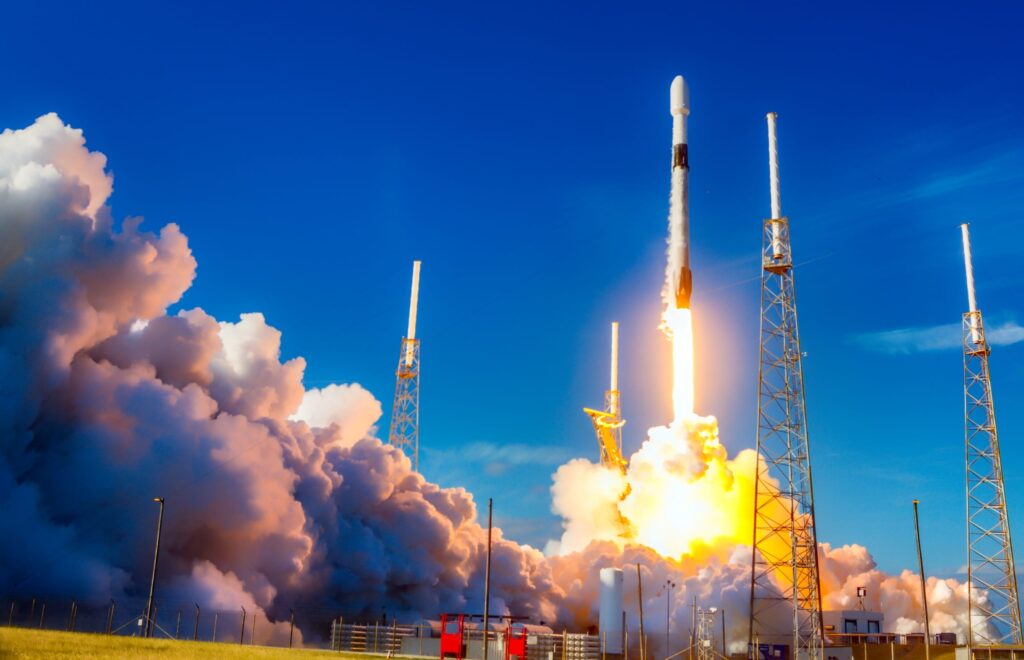
Innovative Fiber Optic Solutions for Aeronautics and Space
In aeronautics and space, photonics is pivotal for technological advancement and mission success. It underpins opto-pyrotechnic ignition systems, ensures structural health monitoring, and facilitates remote sensing. Photonics is also integral to satellite functionality and space exploration, providing the precision and reliability necessary for cutting-edge aerospace applications.
What sets us apart?
A complete and safe opto-pyro system includes a laser firing unit emitting a NIR light pulse travelling through a ground optical harness to the target, i.e. an IOP (opto-pyro initiator) or a DOP (opto-pyro detonator) into launchers, thrusters, missiles or explosives.
Photonics can be used to monitor the health and performance of aerospace structures. For example, optical sensors can be embedded in materials or structures to monitor strain, temperature, gases, and other parameters, allowing for early detection of potential issues. Optical sensors have multiple advantages, they are small, lightweight, resistant to high temperatures and pressure, electromagnetically passive…
Imaging spectroscopy and hyperspectral imaging are techniques allowing fast determination of invisible damage. They can be applied on aircrafts and space vehicles.
Spectroscopy plays an important role in space flight. A spectrometer can be found on almost every modern spacecraft. Satellites, space stations and even Mars planetary rovers use spectrometers in some way, as the measurement of light can be highly valuable in further understanding our universe. A growing area of interest in the space industry involves CubeSats. CubeSats are a type of miniature satellite used for space research and consist of multiple cubic modules. They are also equipped with miniature spectrometers.
IDIL is the world leader for heterodyne velocimetry systems (VH and VISAR). These systems make it possible to study and improve the performance of materials in their resistance to impacts from orbital debris.
Laboratory researches also use spectroscopy to analyse simulation of particular planet’s atmosphere.
