


Fiber sensing


Fiber optic sensing technology for measurements in harsh environments

Fiber optic sensing technologies
In industries like aerospace, automotive, nuclear, and structural health monitoring, traditional measurement technologies rely on bulky electrical wiring, which is susceptible to electromagnetic interference (EMI) and environmental disturbances. These factors can compromise measurement accuracy, especially in demanding environments.
As electronic constraints and limitations continue to grow—particularly in aerospace—there is an increasing demand for optical solutions. IDIL’s fiber optic sensing technology offers a robust alternative, providing real-time, highly accurate measurements that are immune to EMI. This ensures optimized performance, enhanced reliability, and long-term durability, even in the most challenging conditions.
Do not hesitate to ask for more details.
A Fabry-Pérot sensor is an intrinsic fiber sensor. The fiber is only used for transporting the light, but not for the actual sensor. Our Fabry-pérot sensor uses the reflected light between the end of the fiber and the mirror. The change of the distance between the peaks reflection spectrum will indicate the applied elongation, with very high resolution.
For extreme environments, such as high temperatures, high radiation, and waterproof applications, IDIL can manufacture specific Fabry-Pérot sensors with adapted fibers carefully enclosed within hermetically welded tubes. This unique design and welding techniques have been developed by the CEA (Commissariat à l’Énergie Atomique et aux Énergies Alternatives) and transferred to IDIL.
It is not possible to use multiple sensors of that type in a single optical fiber. But IDIL offers the complete multiplexing interrogation unit which can measure up to 8 optical channels with 1 Fabry-Pérot sensor per channel.
A FBG sensor is an extrinsic fiber sensor, the fiber itself acts as a sensor and can deport the acquisition unit. A FBG sensor is an optical device inscribed in a fiber using a UV laser pattern. Acting as a wavelength-selective mirror, it reflects a specific wavelength that shifts in response to strain and/or temperature changes.
FBG sensors provide high-precision measurements thanks to direct wavelength encoding, ensuring robust signal detection over long distances. FBG array sensors enable multiple sensors to operate on a single fiber.
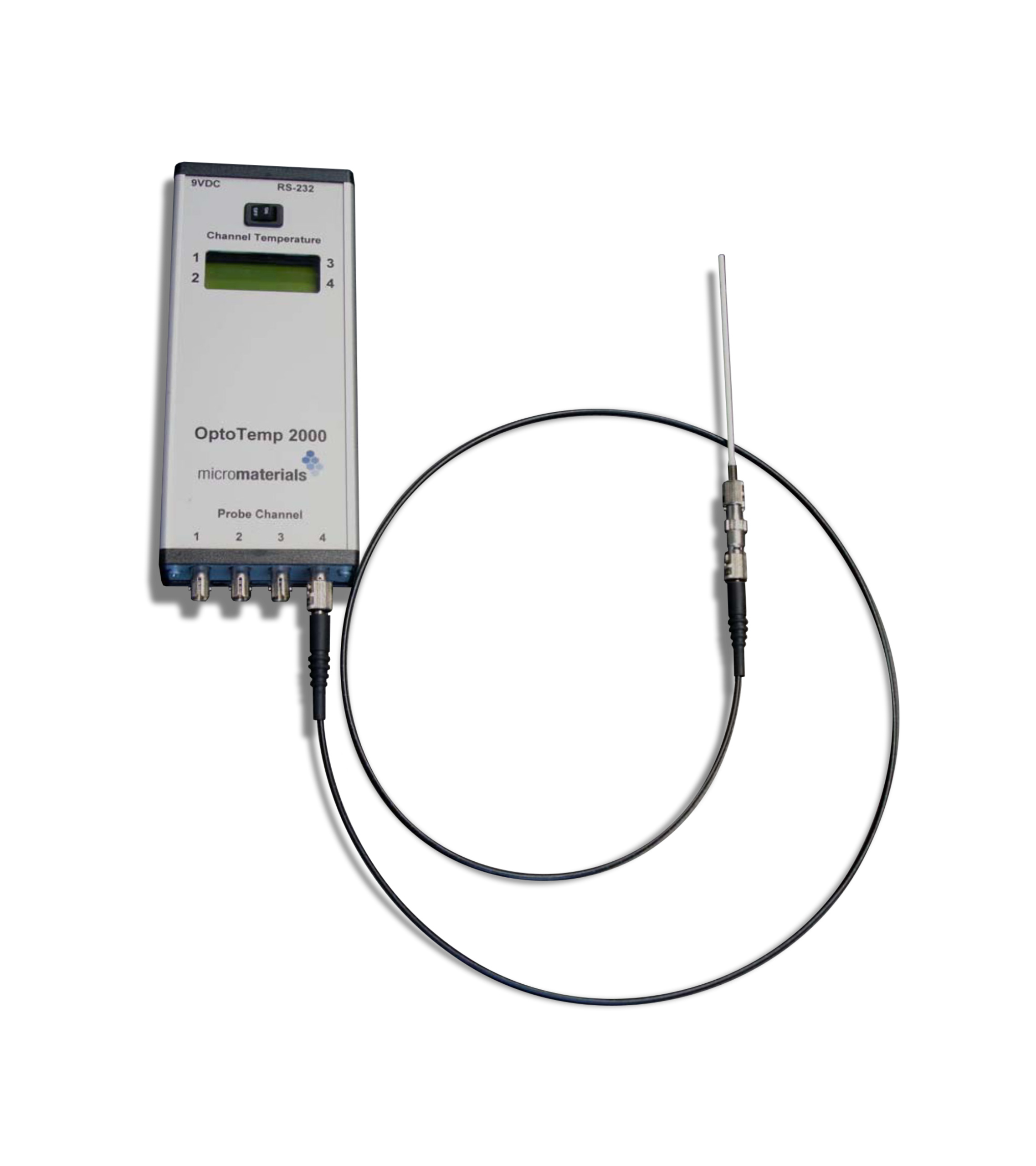
| Thermocouple sensors | Extensometers | FBG sensors | Fabry-Pérot sensors / OptoTemp 2000 | |
| Type | Intrinsic | Intrinsic | Extrinsic | Intrinsic |
| Wire | Electrical wire | Electrical wire | Optical fiber | Optical fiber |
| Lightweight | Yes | No | Yes | No |
| Number of sensors per wire/fiber | 1 (or multiple in multipoint configuration | 1 | Up to 20 | 1 |
| Sensor deployment range | Few meters | Limited (few cm or meters) | Up to several km | Up to several km |
| Immune to EMI | No | No | Yes | Yes |
| Sensitive to environmental disturbances | No | Yes (mechanically sensitive) | No | No |
| Compatible with embedded composites | No | No | Yes | No |
| Temperature resistance | Up to 2300°C (depends on type) | Up to 500°C | Up to 350°C | Up to 800°C / up to 2000 °C |
| High radiation resistance | No | No | No | Yes |
| High pressure resistance | No | No | Yes | Yes |
| Waterproof | No | No | Yes | Yes |
Unlike traditional sensors, FBG and Fabry-Pérot sensors are lightweight, immune to electromagnetic interference and can be embedded into complex structures without being intrusive due to its small dimensions. Embedded strain sensors have been shown to be very effective in detecting and locating material structural damage, which is often not visible with composite materials. Our sensors, both FBG and FP sensors are ideal for sensing and testing new composites as they offer flexibility and seamless integration.
Thanks to their high accuracy and their resistance to extreme environments (high temperatures, radiation conditions, waterproof sensing), fiber sensors lead to numerous applications. Our technologies are ideal for structural health monitoring of aircraft, buildings and dams; improving turbines and industrial equipment efficiency, detecting instabilities within tunnels and power plants, etc.
